Showing posts with label Arthur Kopit. Show all posts

Tuesday, September 28, 2021

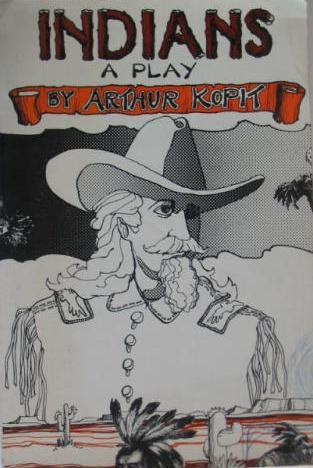
30 PLAYS IN 30 DAYS: Play #28 "Indians" by Arthur Kopit


I have decided for the month of September to read 30 plays in 30 days. It is my belief that, if possible, a play should be read in one sitting to get a better inherent sense of the dramatic arc. Each day, I will write a short post here about the play of the day.

Play #28

Indians by Arthur Kopit

If Arthur Kopit had stopped writing plays after his debut with Oh Dad, Poor Dad, Mamma's Hung You In The Closet And I'm Feelin' So Sad: A Pseudoclassical Tragifarce in a Bastard French Tradition, I would still consider him one of the most important American dramatists of his time, and, perhaps, of any time. That play proved to be prophetic about the sixties and the very notion of revolution, a theme shared in the brilliant one act play Madam Popov by Gladden Schrock. Fortunately for all of us, Kopit continued to write plays, including the brilliant Indians which I have finally read today. 

Again, I am glad that I saved it in a way, because the play seems even more relevant and tragic today as it did at the time it was written. Michael Patterson wrote in The Oxford Guide to Plays that Kopit "turned to a more serious political investigation of the white settlers' treatment of Native Americans," and that "Kopit's play was one of the first major pieces to confront the issue and to relate it to continuing genocide in South-East Asia." 

Indeed, I kept thinking as I read the play how it should be required reading in every high school in America, whether in history or English classes, with discussions about a country built on white supremacy and a notion of exceptionalism. 

Unlike Oh Dad, Poor Dad, which Kopit reportedly wrote in five days (!), Indians took a number of years to research, write, stage, rewrite, re-stage and rewrite some more (Kopit admitted this could have been a process for his entire lifetime with this particular piece). 

Indians sets out to obliterate the American myths of the wild west, our culture of "Cowboys vs. Indians," with the great white roughriders saving innocent white folks from the bloodthirsty savages with their trusty six-shooters. The play deftly cuts between Buffalo Bill's Wild West Show (something that caused a great deal of damage with its mythic nonsense of cowboy heroes, as did the dime novels of Ned Buntline, also a character in the play) and a so-called presidential commission meeting with Sitting Bull to hear their grievances about the American government's lies and broken promises to his people.  And the play also deals with the massacre at Wounded Knee and makes no bones about the fact that it was a completely politically motivated act of genocide. 

While this theater blog and this project is not meant to be political, I cannot help but say for a moment that the history of America needs to be told in honest terms. I even know people who will say it is tragic what happened, but seem to say so with a tone that suggest that it had to be this way. As Indians helps to reinforce, IT DID NOT HAVE TO BE THIS WAY. The American Government chose for it to be this way. When cheating Indigenous People out of their land, moving them to reservations, refusing to help them as promised, when all this didn't work, then there were the smallpox blankets, the massacres, the notion of wiping them out as though they were just a speedbump in progress. It did not have to be this way. Sadly, what people aren't really saying is, "It had to be this way to maintain white dominance, supremacy, and expansion." 

But back to the theater...

Kopit's final script is brilliantly structure, powerful and heartbreaking. Like his other pieces, it is also wonderfully theatrical and moves along at an exceptional pace, with brilliant dialogue, visual mastery and moment of dark and ironic humor. He clearly researched this with his heart and kept working to make it the best version of itself it could be, and it shows. 

After productions in London and Washington (with rewrites after each), Indians opened in New York on Broadway in October of 1969. Theater heavyweight Stacy Keach played Buffalo Bill, and other greats like Manu Tupou, Raul Julia, Charles Durning, and Sam Waterston appeared in it. And as much as I loved reading it, I am sure it is even more powerful to watch. 

The play was nominated for the Pulitzer Prize and a Tony Award. In 1976, Robert Altman adapted it into a movie called Buffalo Bill and the Indians, or Sitting Bull's History Lesson, which did not fare well as the country was celebrating its bicentennial.

Aruthur Kopit would also be a Pulitzer finalist for his play Wings, which also received a Tony nomination for Best Play. He would receive another Tony nomination for Best Book of a Musical for Nine, an adaptation of the film 81/2. With his Nine collaborator, he wrote the book for Phantom, an adaptation of The Phantom of the Opera that was overshadowed by Andrew Lloyd Webber's, though many critics prefer the Kopit version with music by Maury Yeston.

Sadly, Mr. Kopit passed away just this last April at the age of 83. He had been living with progressive dementia prior to his death. 

He will always be one of my heroes, and reading Indians today only solidifies my feelings on the matter. 

If you are interested in producing the play, it is licensed by Concord Theatricals, and you can learn more about it by CLICKING HERE.

Thanks for reading, and feel free to comment with your thoughts on this play or on Arthur Kopit below. If you are looking for a great Christmas play, check out A Wicked Christmas Carol, by me, which combines the worlds of Dickens and L. Frank Baum's Oz books. You can learn more by CLICKING HERE.

Thursday, March 28, 2013

Meaning? What Meaning?: Why Bobby Keniston Loves the Theatre of the Absurd

While I Do Not Advocate Smoking, I DO Advocate Samuel Beckett, particularly Wating For Godot
Hello everyone, and welcome to Theater is a Sport.  I am your host.  My name is Bobby Keniston, and I will be your host on this blog. That's right, I'm your host.  (repetition is key in so many things)  If you're worried about reading a blog about theater by some random guy , I will happily tell you that I have been a lifelong student of theater, in acting, directing and playwriting.  In fact, I'm a playwright with over 20 published titles (please don't feel bad if you haven't heard of me). 

Judging by the title of this post, and the picture of Mr. Samuel Beckett, I am sure you clever folks must know that today's post is about the Theatre of the Absurd.  What it is, some of the biggest names involved, and, really, why I like it so much.  You might even say I love it.  Well, not all of it, of course, but, if I were forced to choose my favorite type of theatre, I mean, was literally FORCED, I would probably answer Theatre of the Absurd.  A big reason will become clear from the pictures of people you will see throughout this post, including Mr. Beckett above, and this fellow below:

Harold Pinter, Nobel Laureate in Literature, and, on some days, my favorite playwright (and in my top five on all days)
Let's start off simply enough with a definition:

THEATRE OF THE ABSURD:  
Theatrical movement beginning in the 1950s in which playwrights created works representing the universe as unknowable and humankind’s existence as meaningless.

Of course, origins of Theatre of the Absurd date back before the 1950s, even all the way back to the tragicomedies of Elizabethan Theatre.  In fact, the mode, or "genre" (for lack of a better word) of most Absurdist plays is tragicomedy.  To quote the play Endgame by Mr. Beckett, "Nothing is funnier than unhappiness.... it's the most comical thing in the world".  Arthur Kopit's 1964 Absurdist masterpiece (at least a masterpiece in my opinion)  Oh Dad, Poor Dad, Mamma's Hung You in the Closet and I'm Feeling So Sad, is subtitled as A Pseudoclassical Tragifarce in a Bastard French Tradition, and that is certainly a dark comedy that achieves a sense of tragedy as well. 

And, yes, Theatre of the Absurd began as a French movement. 

Okay, let's look at some characteristics of Theatre of the Absurd:

---  Theatre of the Absurd, as mentioned before, puts into question the meaning of humankind's existence, and often finds that there is absolutely none.  Building on this point, Theatre of the Absurd often presents a protagonist who is almost a puppet to some unseen force, with no control whatsoever to the world around him (forgive the pronoun). 

---  Because life is not backed by any sense of meaning, in the Theatre of the Absurd, logical communication ceases to exist, leading to a complete breakdown of communication and, well, eventually and inevitably, silence.  A simpler way to say this is that many playwrights dipping into the Absurd will play with language a great deal.  One need only to the character Lucky in Waiting for Godot for an example of communication going completely haywire.  Mr. Pinter, who, as I mentioned, is a favorite of mine, says so much in his pauses.  I don't know if there is a playwright who uses ellipses (...) as well as he does. 

--- Some Theatre of the Absurd almost actively wants to parody the notion of what constitutes as a well-made play.  Look at Eugene Ionesco's The Bald Soprano, which he called "an anti-play".  In fact, why not take a look at this picture of Mr. Ionesco:
Mr. Ionesco, no doubt on the lookout for a charging rhinoceros
--- A good deal of Theatre of the Absurd mixes a kind of interesting stew of broad comedy, even Vaudevillian or slapstick (see Waiting for Godot--- Beckett loved Vaudeville), and mixes it with horrific things and tragedy.  After all, in a world without meaning, there is bound to be severe tonal shifts, wouldn't you say?

--- Many Absurdists plays may have a cyclical nature, in some ways representing the idea of humankind making the same damn mistakes over and over again. 

---- Big old wordplay.  Some of my favorite comes from Tom Stoppard in Rosencrantz and Guildenstern are Dead, like their wonderful game of questions or referrng to England as "a conspiracy of cartographers". 

Why do I love the Theatre of the Absurd?   Look, I'm not a literary critic, I just know what I like, and largely, what I like are things that effect me viscerally.  Things I feel deep in my bones and that stay with me long afterwards.  There are many types of plays and musicals that do this for me, but, the largest percentage is represented by the Theatre of the Absurd.  I dig it when I go from laughing to being shocked.  I enjoy having to think about why something is making me feel the way it does.  I like the bold audacity that is represented in so many Absurdist works.  And, truly, I like playwrights who ask the big questions and aren't afraid of not giving answers (because, well, to the really big questions, there aren't any). 

Here is a partial list of some of my favorite Absurdist plays that I recommend to anyone and everyone (no particular order, just as I think of them) :

Waiting for Godot by Samuel Beckett
Happy Days by Samuel Beckett
The Caretaker by Harold Pinter
A Slight Ache by Harold Pinter
The Dumb Waiter by Harold Pinter
The Maids by Jean Genet
A Night Out by Harold Pinter
The Chairs by Eugene Ionesco
The Zoo Story by Edward Albee
Rhionoceros by Eugene Ionesco
Endgame by Samuel Beckett
The Homecoming by Harold Pinter
Rosencrantz and Guildenstern are Dead by Tom Stoppard
Exit the King by Eugene Ionesco
The Killer by Eugene Ionesco
Amedee or How to Get Rid of It by Eugene Ionesco
Jack or the Submission by Eugene Ionesco
Oh Dad, Poor Dad, Mamma's Hung You in the Closet and I'm Feeling So Sad by Arthur Kopit
God by Woody Allen
The Sandbox by Edward Albee
The American Dream by Edward Albee
The Nature and Purpose of the Universe by Christopher Durang
Firebugs by Max Frisch

Okay, so that's only a partial list, but there are plenty more.  That's enough to get anyone interested started, however.

Thanks for checking out my blog today.  Feel free to follow the links below to find out more about me.  In the meantime, life can be absurd, so it's important to remember that theater is a sport.  Bye bye.
https://www.facebook.com/#!/TheaterIsASport
https://www.facebook.com/#!/pages/Bobby-Keniston-Playwright-Page/148232788536601