Showing posts with label truth. Show all posts

Tuesday, September 28, 2021

30 PLAYS IN 30 DAYS: Play #28 "Indians" by Arthur Kopit


I have decided for the month of September to read 30 plays in 30 days. It is my belief that, if possible, a play should be read in one sitting to get a better inherent sense of the dramatic arc. Each day, I will write a short post here about the play of the day.

Play #28

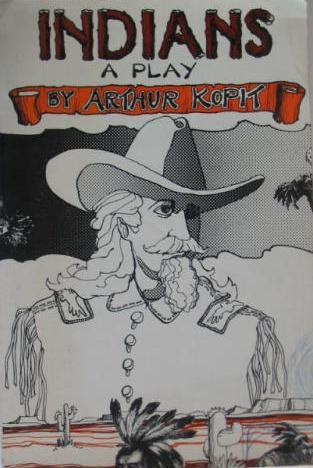
Indians by Arthur Kopit

If Arthur Kopit had stopped writing plays after his debut with Oh Dad, Poor Dad, Mamma's Hung You In The Closet And I'm Feelin' So Sad: A Pseudoclassical Tragifarce in a Bastard French Tradition, I would still consider him one of the most important American dramatists of his time, and, perhaps, of any time. That play proved to be prophetic about the sixties and the very notion of revolution, a theme shared in the brilliant one act play Madam Popov by Gladden Schrock. Fortunately for all of us, Kopit continued to write plays, including the brilliant Indians which I have finally read today. 

Again, I am glad that I saved it in a way, because the play seems even more relevant and tragic today as it did at the time it was written. Michael Patterson wrote in The Oxford Guide to Plays that Kopit "turned to a more serious political investigation of the white settlers' treatment of Native Americans," and that "Kopit's play was one of the first major pieces to confront the issue and to relate it to continuing genocide in South-East Asia." 

Indeed, I kept thinking as I read the play how it should be required reading in every high school in America, whether in history or English classes, with discussions about a country built on white supremacy and a notion of exceptionalism. 

Unlike Oh Dad, Poor Dad, which Kopit reportedly wrote in five days (!), Indians took a number of years to research, write, stage, rewrite, re-stage and rewrite some more (Kopit admitted this could have been a process for his entire lifetime with this particular piece). 

Indians sets out to obliterate the American myths of the wild west, our culture of "Cowboys vs. Indians," with the great white roughriders saving innocent white folks from the bloodthirsty savages with their trusty six-shooters. The play deftly cuts between Buffalo Bill's Wild West Show (something that caused a great deal of damage with its mythic nonsense of cowboy heroes, as did the dime novels of Ned Buntline, also a character in the play) and a so-called presidential commission meeting with Sitting Bull to hear their grievances about the American government's lies and broken promises to his people.  And the play also deals with the massacre at Wounded Knee and makes no bones about the fact that it was a completely politically motivated act of genocide. 

While this theater blog and this project is not meant to be political, I cannot help but say for a moment that the history of America needs to be told in honest terms. I even know people who will say it is tragic what happened, but seem to say so with a tone that suggest that it had to be this way. As Indians helps to reinforce, IT DID NOT HAVE TO BE THIS WAY. The American Government chose for it to be this way. When cheating Indigenous People out of their land, moving them to reservations, refusing to help them as promised, when all this didn't work, then there were the smallpox blankets, the massacres, the notion of wiping them out as though they were just a speedbump in progress. It did not have to be this way. Sadly, what people aren't really saying is, "It had to be this way to maintain white dominance, supremacy, and expansion." 

But back to the theater...

Kopit's final script is brilliantly structure, powerful and heartbreaking. Like his other pieces, it is also wonderfully theatrical and moves along at an exceptional pace, with brilliant dialogue, visual mastery and moment of dark and ironic humor. He clearly researched this with his heart and kept working to make it the best version of itself it could be, and it shows. 

After productions in London and Washington (with rewrites after each), Indians opened in New York on Broadway in October of 1969. Theater heavyweight Stacy Keach played Buffalo Bill, and other greats like Manu Tupou, Raul Julia, Charles Durning, and Sam Waterston appeared in it. And as much as I loved reading it, I am sure it is even more powerful to watch. 

The play was nominated for the Pulitzer Prize and a Tony Award. In 1976, Robert Altman adapted it into a movie called Buffalo Bill and the Indians, or Sitting Bull's History Lesson, which did not fare well as the country was celebrating its bicentennial.

Aruthur Kopit would also be a Pulitzer finalist for his play Wings, which also received a Tony nomination for Best Play. He would receive another Tony nomination for Best Book of a Musical for Nine, an adaptation of the film 81/2. With his Nine collaborator, he wrote the book for Phantom, an adaptation of The Phantom of the Opera that was overshadowed by Andrew Lloyd Webber's, though many critics prefer the Kopit version with music by Maury Yeston.

Sadly, Mr. Kopit passed away just this last April at the age of 83. He had been living with progressive dementia prior to his death. 

He will always be one of my heroes, and reading Indians today only solidifies my feelings on the matter. 

If you are interested in producing the play, it is licensed by Concord Theatricals, and you can learn more about it by CLICKING HERE.

Thanks for reading, and feel free to comment with your thoughts on this play or on Arthur Kopit below. If you are looking for a great Christmas play, check out A Wicked Christmas Carol, by me, which combines the worlds of Dickens and L. Frank Baum's Oz books. You can learn more by CLICKING HERE.

Friday, March 20, 2015

THE TRUTH ABOUT MAKING MONEY WRITING PLAYS FOR THE AMATEUR THEATER MARKET or PLEASE DON'T RIP OFF PLAYWRIGHTS


WRITING PLAYS = $$$$$$$$$$$$$$$$$$$$$

Whoa!  Slow down.  As much as I would love to have you believe that I can teach you how to earn fat stacks of cash by writing plays, I really can't.  I'd like to, honest.  But first, I would have to be proficient in making fat stacks of cash by writing plays, and, though I'm happy and grateful for all the successes I have achieved, I do not make a living writing plays.

Welcome to Theater is a Sport.  My name is Bobby Keniston, and this is my little piece of the internet that I use to write about theater.  Thanks for stopping by.

Today I want to talk about writing plays for the amateur market (schools, community theaters, etc.), and the truth about how the money works.  If you're looking for the financial possibilities for a playwright who has a play on Broadway, you've come to the wrong place.  Sorry.

There's an old expression, credited to Robert Anderson, that says you can make a killing on Broadway, but you can't make a living.  And it's true--- many of the top playwrights working today supplement their income working for the movies.  Which really means, these screenwriters supplement their income writing plays.

The late Tim Kelly, who published over 350 plays for the amateur market, once gave  talk describing how one could make a living writing for the amateur market, the way way way way way way off-Broadway stages.  Mr. Kelly admitted that writing for this market wasn't going to bring you critical acclaim, or glitz and glamour, but you could make a living.

By and large, I think Mr. Kelly is right.  But it's not easy.  If you've ever glanced through school and community theater catalogs for plays, you might notice that a playwright's name shows up many many times.  In the five years since I've first been published, I know have 33 plays with four different publishers, and have been called prolific by some people.  This might seems like a lot, but I would appear practically blocked next to many of my colleagues.  To make headway in the school and community theater markets, you need to write and focus on output.  However, you must also focus on quality, so that you'll be published and produced in the first place.

Even though this is a theater blog, I'm going to do a little bit of math right now to demonstrate.  I'm often asked by people about the financial side of my career, not out of nosiness, but out of a genuine curiosity of how it works.  I know I didn't know much about it until I was published.  In fact, to be honest, I was a bit naive.  I thought a few plays doing well meant moolah city, but it's really not that simple.

So, that one act play you write for middle schools and high schools (and yes, you want it to be suitable for both if at all possible) has just been accepted for publication!  Congratulations!  You deserve to celebrate!  And this excitement is well-deserved... it's not easy to be a published playwright!  So feel free to dance around.  I'll bet you even get goosebumps when you sign that first contract.

Now, you're a person who's looking to make writing plays for schools and community theaters a full out career.  Please do not quit your job just yet after your first publication.  Unless you've got huge savings to draw from, or are independently wealthy, in which case, go for it.  But for the rest of us, stay employed.

So, most likely, if you've just got your first one act play published, your publisher will offer it out in their catalog for a licensing fee of anywhere between $35 and $45 a performance.  Of this sum, you, the playwright, will receive anywhere between 50-60%, sometimes more, depending on the company. A good number of my plays, I receive 60% of the performance royalty.  Others, I receive 50%.  It's important to not just look at this percentage, but also to the quality of the catalog, how often it's mailed out, it's reputation for handling plays, etc.

Okay, along with this percentage of the performance royalty, you will also (most likely) receive a 10% royalty on the book sales.  For a one act play, an individual script can cost anywhere between $5.95 and $7.99, depending on the publisher.  To be honest, it wasn't until I had a few plays published that I made sure I received a royalty on script sales, but it's important to have.

For the amateur market, it is very unlikely that you will get any kind of advance, like you might for a novel.  By and large, advances for playwrights go to the shows with the big New York runs and reviews.  I've heard of only one amateur market publisher who paid an advance, and it may very well have been due to the author's previous successes.

Now, on a special note, again, before you quit that day job... pay special attention to when royalties are paid out.  Some companies pay twice a year, a select few pay quarterly, and some only once a year.

So, you want to make a living.  Well, what's a living?  Let's look at something as simple as $20,000.  I should note, I have yet to make this much in a single year from my playwriting, but I do okay.

Let's split the difference, and say your one act play is licensed for a $40 royalty per performance, and your contract gives you 60%.  That means your cut for each performance is $24.  This means you would need to have your play performed 834 times to make $20,016 from a performance royalty.  Now, let's say that the average number of performances a school will license is 3.  You will need 278 productions of 3 performances each to make that money.

Now, factoring in book sales:  let's say that each school needs to order ten books, that are priced $6 a piece.  That gives you another $6 per production.  So $6 multiplied by 278 gives you another $1,668, for a grand total of $21,684.  Well that's not too bad for a one act play, now is it?

Unfortunately, you'd have to be the rarest of the rare, or luckiest of the luckiest to hope that your one act play received 278 productions in one year, for 834 performances.  It's a pretty full market.  The play catalogs are thick, after all.  Yours is but one name among hundreds.  You'd be pretty lucky to have your play receive 25 productions in its first year (much better than mine did).  And, even more likely, it will be lower than that.

(Starting to see why we publish a lot?)

I don't mean this example to be discouraging, but just honest.  It is often true in this market that the harder you work the more successful you become, so that's a good thing.  Try not to think of yourself as competing with other playwrights, because you're not, not really.   You're competing with yourself to keep creating quality work at a decent rate.

All I really wanted to show here is how playwrights for this market are compensated, and how, not licensing a production, or not paying for every performance, is truly stealing money from a playwright's pocket.  And it adds up.

I've been saying this a lot lately, but you can't claim to support the arts without paying the money to support artists.

Thanks for wandering through this little lesson in finance with me.  Again, it's all relative--- some folks are lucky and publish major hits that do get hundreds of productions a year.  And if you become one of them, good for you!  I hope to become one too, and that's why I keep telling my stories.

Until next time, thanks for reading Theater is a Sport.  You can learn more about my plays by clicking HERE,  HERE, HERE, or HERE.  Thanks for reading, and feel free to comment below.