Wednesday, September 29, 2021

30 PLAYS IN 30 DAYS: Play #29 "Salomé" by Oscar Wilde


I am reading 30 Plays in the 30 Days of September and discussing them here. I can't believe the month is almost over...

Play #29

Salomé by Oscar Wilde

The original version of this play was written in French in 1891 and translated into English three years later. The first production was in Paris in 1896, because it was banned in Britain because of its depiction of Biblical characters. It would not be performed there until 1931. 

One might remember that this play was written before Oscar Wilde had success with plays such as A Woman of No Importance and The Importance of Being Earnest (which I had the pleasure of directing a while back). This one act tragedy bears little resemblance the quick witted comedies that many associate with Wilde, though the luxurious use of language is still on display. 

Salomé is the stepdaughter of Herod Antipas, who is having a drunken party. He and his guests have been leering inappropriately at Salomé all evening, so she steps away and hears the voice of Jokanaan the prophet (John the Baptist), who is being held prisoner. She demands to see him, even though it is not allowed, and is drawn to him, though he calls her harlot and such. She wants to kiss his mouth and he rejects her. She persists and he continues to reject her, to the point where the young Syrian captain of the guard, upset that she wants another man, kills himself. Right there between them. Just kills himself. 

Right there. 

Salomé doesn't pay the corpse much mind but tells Jokanaan that she will kiss his mouth one day. He is taken back to his cell, and Herod comes to find Salomé, slipping on the blood of the young captain (a bad omen--- of course). The old perv wants his stepdaughter to dance for him, even though his wife, Salomé's mother Herodias, is right there. Salomé says she will dance for Herod, against her mother's objections, so long as Herod swears to give her anything she wants in return. He gives the oath. She dances the dance of the seven veils. Herod is super happy, the old perv. Then Salomé tells him what she wants. 

The head of Jokanaan. (spoiler alert: yes, she does kiss it)

Salomé is not named in the Bible, but is only known as Herod's stepdaughter who asks for the head of John the Baptist. Apparently, Oscar Wilde has been interested in writing on the subject of Salomé since his Oxford days. 

Like most everything Wilde ever wrote, it is a well-written with wonderful turns of phrase:

"Only in mirrors should one look," says Herod in one of his speeches, "for mirrors do but show us masks."

Salomé has been adapted in many different media (including a film with Al Pacino and Jessica Chastain), and there are countless pieces of art depicting the young woman with a head on a platter. For all of this, I do not think this particular play is what people think of when they think of Oscar Wilde... I know I can't help but think of Earnest or An Ideal Husband or his beautiful collection of fairy tales. I once had the good fortune to play Oscar Wilde himself (though he was much, much taller than I) in a production of a play called Wilde West by Charles Marowitz, which depicts on Wilde on his American tour (which did happen) where he meets outlaw Jesse James (which did not happen). It was a great pleasure to play a genuine genius and to learn about his life. 

Have you read Salomé?  Let me know in the comments!

Tuesday, September 28, 2021

30 PLAYS IN 30 DAYS: Bonus Play "My Left Breast" by Susan Miller


Here is another bonus play for my "30 Plays in 30 Days" September reading challenge. My Left Breast by Susan Miller is a one-woman show that I found in a collection I have of The Best American Short Plays 1993-1994. The play originally premiered at the Actors Theatre of Louisville in the 1994 Humana Festival where Miller performed the piece herself. 

A multi-layered monologue, My Left Breast tells the story of a "one-breasted, menopausal, Jewish bisexual lesbian Mom", from a diagnoses of breast cancer through a mastectomy, from raising her son, to a breakup of a long-term relationship, and a diagnoses of osteoporosis... and through it all, Miller tells the story in a very human way, with plenty of humor, insight and poignancy.  I found the descriptions in the aftermath of her breakup relatable, and one can feel the no-holds barred honesty as she approaches each subject with a kind of grace in her writing.

Susan Miller received an Obie and shared the 1994/1995 Blackburn Prize for the play. It is published by Playscripts, Inc., a very fine publishing house (they carry two of my plays), so if you are interested in reading the play or licensing it for performance, you can visit their website by CLICKING HERE.

If you know this play, have read it, seen it, or performed it, let me know your thoughts by commenting on this post. If you would like to learn more about my plays, you can do so by CLICKING HERE.

30 PLAYS IN 30 DAYS: Play #28 "Indians" by Arthur Kopit


I have decided for the month of September to read 30 plays in 30 days. It is my belief that, if possible, a play should be read in one sitting to get a better inherent sense of the dramatic arc. Each day, I will write a short post here about the play of the day.

Play #28

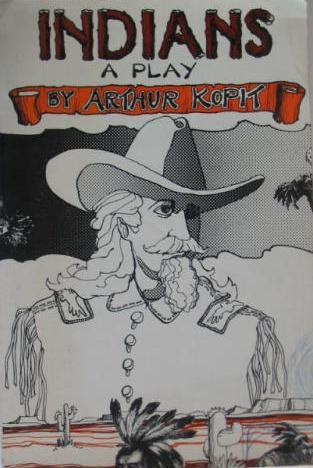
Indians by Arthur Kopit

If Arthur Kopit had stopped writing plays after his debut with Oh Dad, Poor Dad, Mamma's Hung You In The Closet And I'm Feelin' So Sad: A Pseudoclassical Tragifarce in a Bastard French Tradition, I would still consider him one of the most important American dramatists of his time, and, perhaps, of any time. That play proved to be prophetic about the sixties and the very notion of revolution, a theme shared in the brilliant one act play Madam Popov by Gladden Schrock. Fortunately for all of us, Kopit continued to write plays, including the brilliant Indians which I have finally read today. 

Again, I am glad that I saved it in a way, because the play seems even more relevant and tragic today as it did at the time it was written. Michael Patterson wrote in The Oxford Guide to Plays that Kopit "turned to a more serious political investigation of the white settlers' treatment of Native Americans," and that "Kopit's play was one of the first major pieces to confront the issue and to relate it to continuing genocide in South-East Asia." 

Indeed, I kept thinking as I read the play how it should be required reading in every high school in America, whether in history or English classes, with discussions about a country built on white supremacy and a notion of exceptionalism. 

Unlike Oh Dad, Poor Dad, which Kopit reportedly wrote in five days (!), Indians took a number of years to research, write, stage, rewrite, re-stage and rewrite some more (Kopit admitted this could have been a process for his entire lifetime with this particular piece). 

Indians sets out to obliterate the American myths of the wild west, our culture of "Cowboys vs. Indians," with the great white roughriders saving innocent white folks from the bloodthirsty savages with their trusty six-shooters. The play deftly cuts between Buffalo Bill's Wild West Show (something that caused a great deal of damage with its mythic nonsense of cowboy heroes, as did the dime novels of Ned Buntline, also a character in the play) and a so-called presidential commission meeting with Sitting Bull to hear their grievances about the American government's lies and broken promises to his people.  And the play also deals with the massacre at Wounded Knee and makes no bones about the fact that it was a completely politically motivated act of genocide. 

While this theater blog and this project is not meant to be political, I cannot help but say for a moment that the history of America needs to be told in honest terms. I even know people who will say it is tragic what happened, but seem to say so with a tone that suggest that it had to be this way. As Indians helps to reinforce, IT DID NOT HAVE TO BE THIS WAY. The American Government chose for it to be this way. When cheating Indigenous People out of their land, moving them to reservations, refusing to help them as promised, when all this didn't work, then there were the smallpox blankets, the massacres, the notion of wiping them out as though they were just a speedbump in progress. It did not have to be this way. Sadly, what people aren't really saying is, "It had to be this way to maintain white dominance, supremacy, and expansion." 

But back to the theater...

Kopit's final script is brilliantly structure, powerful and heartbreaking. Like his other pieces, it is also wonderfully theatrical and moves along at an exceptional pace, with brilliant dialogue, visual mastery and moment of dark and ironic humor. He clearly researched this with his heart and kept working to make it the best version of itself it could be, and it shows. 

After productions in London and Washington (with rewrites after each), Indians opened in New York on Broadway in October of 1969. Theater heavyweight Stacy Keach played Buffalo Bill, and other greats like Manu Tupou, Raul Julia, Charles Durning, and Sam Waterston appeared in it. And as much as I loved reading it, I am sure it is even more powerful to watch. 

The play was nominated for the Pulitzer Prize and a Tony Award. In 1976, Robert Altman adapted it into a movie called Buffalo Bill and the Indians, or Sitting Bull's History Lesson, which did not fare well as the country was celebrating its bicentennial.

Aruthur Kopit would also be a Pulitzer finalist for his play Wings, which also received a Tony nomination for Best Play. He would receive another Tony nomination for Best Book of a Musical for Nine, an adaptation of the film 81/2. With his Nine collaborator, he wrote the book for Phantom, an adaptation of The Phantom of the Opera that was overshadowed by Andrew Lloyd Webber's, though many critics prefer the Kopit version with music by Maury Yeston.

Sadly, Mr. Kopit passed away just this last April at the age of 83. He had been living with progressive dementia prior to his death. 

He will always be one of my heroes, and reading Indians today only solidifies my feelings on the matter. 

If you are interested in producing the play, it is licensed by Concord Theatricals, and you can learn more about it by CLICKING HERE.

Thanks for reading, and feel free to comment with your thoughts on this play or on Arthur Kopit below. If you are looking for a great Christmas play, check out A Wicked Christmas Carol, by me, which combines the worlds of Dickens and L. Frank Baum's Oz books. You can learn more by CLICKING HERE.

Monday, September 27, 2021

30 PLAYS IN 30 DAYS: BONUS PLAY "Come Down Burning" by Kia Corthron


Today, I have another bonus play. I read a full-length, and, tonight, read a brilliant one act play called Come Down Burning by Kia Corthron. It is in a collection called The Best American Short Plays 1993-1994, which was given to me by my high school drama coach and dear friend, Tom Lyford. 

Kia Corthron has written many plays, as well as the novel The Castle Cross the Magnet Carter which won the 2016 Center For Fiction First Novel Prize. She also wrote episodes for the television series The Jury and The Wire. 

Come Down Burning centers around two grown sisters: Skoolie, the elder sister, who is paralyzed from her waist down due to a fall from tree as a child, and Tee, the younger sister with three children, who always needs help from Skoolie. It is established that Skoolie is the strong one, despite her physical condition, and she can move around fiercely in a wooden cart her father had made for her years ago, a cart with wheels on the bottom. Already, Corthron has inverted a cliche in a terrific manner by making Skoolie the one who takes care of the family. Tee has moved in with her three children, ages 9, 6 and a baby of just 3 months, and we learn it is not the first time that Skoolie has had to take Tee in and take care of her. Tee defers to Skoolie on most things, like how best to feed the baby, and how to deal with a mean teacher who is singling out her daughter, but this begins to build a kind of resentment--- in truth, a feeling that has probably been building in Tee for years

Skoolie makes money doing hair, and also performing illegal abortions on the side. Though Tee has three children is pregnant again, we learn two of her children had died, most likely because of malnourishment brought on by poverty. Class, race and poverty is dealt with in a strong manner in this play, though not in any way that feels preachy. Tee needs to make a decision about the pregnancy, and how to move forward, and if she can even move forward without her older sister's help. 

But even more than help, she wants Skoolie's approval. 

I will not go into the ending here, only to say that it was a very powerful piece and that Corthron packs a great deal of emotion into a a short piece. Her language is also poetic, yet still feels natural and real. 

Come Down Burning had a workshop production at the Long Wharf Theatre, and then premiered at the American Place Theater in 1993. To learn more about it, or to order a copy yourself, you can CLICK HERE.

Thanks for reading, and please feel free to comment if you have any thoughts about Kia Corthron's intense one act play, or with any recommendations for plays that I may not have read or discussed. If you would like to learn more about my published plays, please CLICK HERE. 

30 PLAYS IN 30 DAYS: Play #27 "Mary, Mary" by Jean Kerr


 I have decided for the month of September to read 30 plays in 30 days. It is my belief that, if possible, a play should be read in one sitting to get a better inherent sense of the dramatic arc. Each day, I will write a short post here about the play of the day.

Play #27

Mary, Mary by Jean Kerr

Mary, Mary opened on Broadway in March of 1961 at the original Helen Hayes Theater. It ran for 3 years and 9 months before it transferred to the Morasco. It ended up closing December 12, 1964 after 1,572 performances. 

Let me say it again--- 1,572 performances. 

That makes it the longest-running non-musical play of the 1960s.  The play ran much longer than the film adaptation of it. 

Now, if you were to have asked me what the longest-running Broadway non-musical play of the 1960s had been I probably would have guessed one of Neil Simon's comedies, either The Odd Couple or Barefoot in the Park. 

How happy I am to have been wrong!  I confess, I find it incredibly refreshing that a female playwright writing a character about a woman who has grown in to finding her agency was such an incredible success. And here's the thing--- it is a pure joy to read, and I imagine is even more fun to see onstage. 

Mary, Mary begins with Bob, divorced for about nine months, in the midst of planning to get remarried to Tiffany. He is having money and tax problems, so his friend Oscar, an accountant, comes to his apartment to help him out. Unbeknownst to Bob, Oscar has asked Bob's ex-wife, the titular Mary, to come and help, as she might be able to help, as she and Bob had shared expenses before their divorce. Bob is nervous to see Mary, to the extent that he doesn't want to be left alone with her, and certainly doesn't want Tiffany, his new bride-to-be to meet her. When Mary arrives, she is stronger, more fashionable and perhaps a bit more confident than her ex-husband remembers. 

And she is very funny. 

Yes, I think Mary is a very cool character who, after the divorce (which was her husband's idea), has worked to become the version of herself that she wants to be. Yes, she still has feelings for ex-husband, and yes, sometimes her confidence wavers, but this is a character who, as John Gassner put it, is just as intelligent and funny as... well, Jean Kerr herself.  I like how the play even ends on Mary's own terms. Further, the role of Tiffany, the younger new wife, is also treated like a genuine character, in a role that many playwrights might have written as an airhead young trophy wife, Tiffany also shows her own agency and deeper layers.  

There is a subplot about a movie star who wants to publish a book with Bob's publishing company who meets Mary and develops feelings for her, seeing her in a way that Bob never did... until, perhaps, it was too late.

Or was it?

This is by no means a perfect play, but I understand why it was so successful. These characters are pleasant to be around. Jean Kerr, also known for her best-selling collection of essays, Please Don't Eat the Daisies, has one-liners that even Neil Simon would admire. And sorry to keep making the Neil Simon comparison, but I just find it strange that I had never really heard of Jean Kerr's plays until recently. I wonder why she or this comedy isn't as widely produced as some of Simon's classics. Yes, the play is a little dated perhaps, but so are Neil's. 

In any case, the play didn't exactly end as I had wanted it to, but it ended in an honest way that, again, didn't short change Mary's growth as a character, and even allowed Bob a little growth, too. Underneath the jokes, there are some genuine ideas about relationships and men and women that might not be groundbreaking, but are interesting. 

Jean Kerr was married to the Broadway writer and critic Walter Kerr, and they collaborated on such projects as Goldilocks the Musical and the Tony award-winning King of Hearts. 

Jean Kerr passed away in 2003 at the age of 80. Her last play, Lunch Hour was staged in 1980.  

If you're interested in staging Mary, Mary you can learn more about doing so on the Dramatist Play Service Website for it. 

Looking for a great new play for the Christmas season?  Check out my play A Wicked Christmas Carol, which blends the worlds of Dickens and L. Frank Baum's Oz books, providing terrific roles for women with a spin on a classic. CLICK HERE for details. 

Sunday, September 26, 2021

30 PLAYS IN 30 DAYS: BONUS PLAY "This Property is Condemned" by Tennessee Williams


I have given myself the challenge of reading 30 plays for the 30 days of September and to write about them here on my blog. Today, after reading the Summer and Smoke, I was so taken with the Prologue featuring the Young John and Young Alma, that I went back and read Tennessee Williams' short play, This Property is Condemned. And while I will not consider it one of my 30 plays for the 30 days of September (it's probably a 15-minute read, tops, probably closer to 10), I will still discuss it here briefly. 

While Tennessee Williams is primarily known for his full-length works that made him one of the most important American playwrights of the 20th century, (particularly A Streetcar Named Desire and Cat on a Hot Tin Roof,  both winners of the Pulitzer Prize for Drama), I have always been fond of a number of his short plays for their ability to pack some serious emotional weight while being short and precise. I think This Property is Condemned is maybe the best example of this gift. 

The two-character play begins with Tom, about 12 or 13, out with his kite, and a young woman of 13 named Willie is walking down the railroad tracks with a ragged doll in one hand and sorry looking banana in the other. Willie is dressed in clothes that are too old for her, and has childishly rubbed rouge on her face. She asks Willie to hold her doll and and not talk to her until she falls off the tracks--- which she does after a few more moments. 

As the two kids talk, it is clear that Willie is not in the best of circumstances. Since her older sister Alva's death, her life has crumbled. Her sister was promiscuous with the railroad men, or so it was said. Willie's mother ran off with a man from the railroad, and her father took to drinking and disappeared. She lives alone in their house now, which has a sign on it reading: THIS PROPERTY IS CONDEMNED. She is alone, though she says she has inherited her sister's clothes and her beaux. Tom has even heard that Willie danced for one of his friends, which Willie doesn't deny. She merely said she was lonesome at the time. 

Willie is a heartbreaking character, and the short play is a perfect portrait and duet for two talented young performers. I am happy tat Williams doesn't answer every question about Willie's life, and that we don't know exactly when she is lying and when she is telling the truth. It is a fascinating short piece. 

A full-length movie was made in 1966 that expands the story and dramatizes Willie's stories about her older sister Alva. And while I have heard good things about the film, I think I prefer the short, ambiguous, yet emotional piece written for the stage. I don't think we need to see Alva's story. It's about how Alva's story brought Willie to where she is now--- that's the engaging part of it for me. 

I hope you enjoyed this bonus discussion for This Property is Condemned. Please feel free to keep on coming back to my blog.  And if you're interested in a cool new Christmas Play, you can learn about my play A Wicked Christmas Carol that combines the worlds of Dickens and of L. Frank Baum's Oz books by CLICKING HERE

30 PLAYS IN 30 DAYS: Play #26 "Summer and Smoke" by Tennessee Williams


I have decided for the month of September to read 30 plays in 30 days. It is my belief that, if possible, a play should be read in one sitting to get a better inherent sense of the dramatic arc. Each day, I will write a short post here about the play of the day.

Play #26

Summer and Smoke by Tennessee Williams

One can't really have  discussion about 20th century American theater without mentioning Tennessee Williams (born Thomas Lanier Williams III). Along with biggies like Eugene O'Neill, he is considered to be one of the most important dramatists of the era--- his play A Streetcar Named Desire is considered as seminal an American work as O'Neill's Long Day's Journey Into Night and Arthur Miller's Death of a Salesman. His first major success came with The Glass Menagerie when he was just 33, and the prolific, lyrical playwright followed it up with a string of hits, including winning the Pulitzer Prize for Drama twice, once for the aforementioned Streetcar and again for Cat on a Hot Tin Roof. 

Summer and Smoke opened in 1948, his first follow-up to Streetcar, though he had been working on it since 1945 under the title Chart of Anatomy (such a chart is pivotal in the play). The play is sort of a love story (or maybe, more appropriately, a love story that doesn't really happen) between Alma, the minister's daughter, and John, following in his father's footsteps by becoming a doctor. Alma, her name meaning "soul", believes in the spirit within a person, while John is more interested in the flesh. The play is told in two parts--- Summer and Winter--- and in many ways is a philosophical argument between these two ways of looking at humans (argument being the word the characters use). Alma loves John, believes he could ascend to be above what he is in the first part, that is, a drunkard who goes after pleasure where he can find it. By the end, however, Alma and John have reversed, or so we are led to think--- she has "won the argument" according to John, who now believes in the soul, and Alma is no longer sure of such things... only sure that she loves him and can't be with him. Now, I say that John has supposedly changed, though, by the end, he is with a woman who he admits is still "just a child", who we first met as a 16 year-old student with a school girl crush on him.  So... yeah. 

While Tennessee Williams is always a pleasure to read--- he is such a gifted writer and spins an interesting tale that you want to see reconciled--- this play is not his best. Alma really is little more than a symbol for the spirit, and her "nervous attacks" (John gets her hooked on pills for that--- yay) and strange laughter feel more like quirks than actual character traits. John is also too much of a symbol, and, as mentioned before, I did not find his journey believable or earned. Nor did what keeps them apart at the end seem genuine to me, either. 

I know this sounds like I didn't like the play, but that is not true at all. It really is a great read, and Williams, very specific in his stage directions, sets up a nice visual picture, and there are beautifully written monologues. 

Interestingly enough, this story must have kept kicking around in Williams' head, because he rewrote the play in 1964 with the title The Eccentricities of a Nightingale. It is said that he prefers this play to Summer and Smoke, and some of the criticisms about the character Alma are said to be rectified in Nightingale. This, of course, makes me want to find a copy of it so I can do a side-by-side compare/contrast... perhaps some day. 

One final note: the play begins with a Prologue of a young John and Alma at the fountain (which also is of importance in the play). It is a short scene, but I really like it. Williams, in my opinion, was pretty good at writing children, and I almost wish this scene had been longer. Makes me want to take another look at his excellent one-act, This Property is Condemned. 

Thanks for reading, and please feel free to check out the rest of my blog. If you're interested in my plays, you can click HERE, HERE, HERE or even HERE